
Understanding Block-Level Incremental Backups: How SpaceDeckIO Reduces Storage Costs by 90%
Learn how block-level incremental backup technology works and how SpaceDeckIO uses it to dramatically reduce storage costs while maintaining fast backup and recovery times.
Understanding Block-Level Incremental Backups
In today's data-driven world, organizations face a critical challenge: how to protect their data efficiently without breaking the bank on storage costs. Traditional backup methods can consume massive amounts of storage space, leading to escalating costs and management complexity.
The Storage Cost Problem
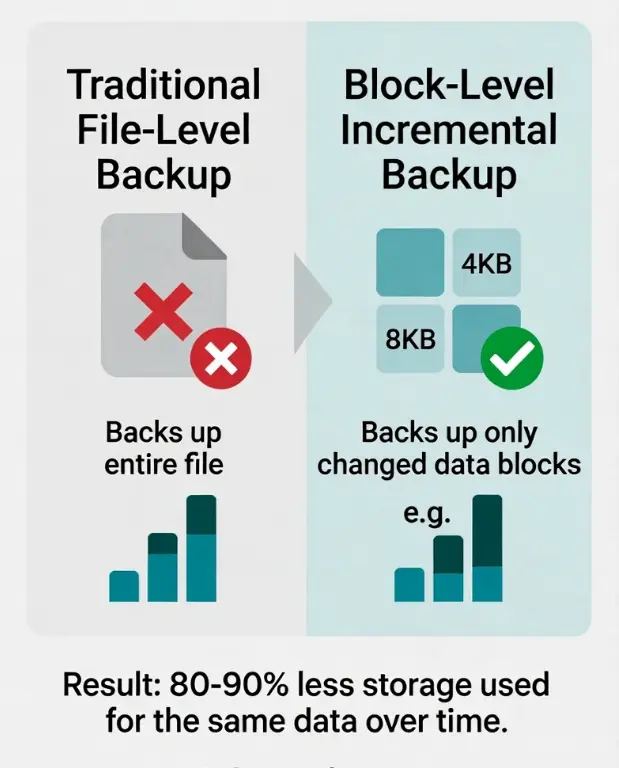
Most enterprise backup solutions use file-level incremental backups, which track changes at the file level. While this is an improvement over full backups, it still has significant limitations:
- Large file changes: If a single byte changes in a 10GB file, the entire file must be backed up again
- Storage inefficiency: Multiple versions of unchanged data blocks are stored
- Bandwidth consumption: Large amounts of data must be transferred even for small changes
What is Block-Level Incremental Backup?
Block-level incremental backup is an advanced backup technology that tracks changes at the block level (typically 4KB or 8KB blocks) rather than at the file level. This means:
- Only changed blocks are backed up: If you modify a small portion of a large file, only the changed blocks are transferred and stored
- Deduplication: Identical blocks across different files or versions are stored only once
- Efficient storage: Storage usage can be reduced by 80-90% compared to file-level backups
How SpaceDeckIO Implements Block-Level Incremental Technology
SpaceDeckIO's backup engine uses sophisticated algorithms to:
1. Block-Level Change Detection
Our system monitors changes at the block level using:
- Volume Shadow Copy Service (VSS) on Windows for consistent snapshots
- Change tracking that identifies modified blocks in real-time
- Checksum verification to ensure data integrity
2. Intelligent Deduplication
SpaceDeckIO's deduplication engine:
- Creates a hash fingerprint for each block
- Stores blocks only once, even if they appear in multiple files
- Maintains references to shared blocks for efficient storage
3. Compression and Optimization
Before storing blocks, SpaceDeckIO:
- Compresses blocks using advanced algorithms
- Encrypts blocks using AES-256 encryption
- Optimizes storage layout for fast retrieval
Storage Efficiency Comparison
Let's compare different backup approaches:
| Backup Type | Storage Used | Transfer Time | Cost Efficiency |
|---|---|---|---|
| Full Backup | 100% | 100% | Low |
| File-Level Incremental | 30-50% | 30-50% | Medium |
| Block-Level Incremental | 5-15% | 5-15% | High |
Real-World Example
Consider a scenario where you have:
- 100GB database that changes 1GB daily
- Backup retention: 30 days
Traditional File-Level Backup:
- Day 1: 100GB (full backup)
- Days 2-30: 1GB × 29 days = 29GB
- Total: 129GB
SpaceDeckIO Block-Level Backup:
- Day 1: 100GB (full backup)
- Days 2-30: ~100MB × 29 days = ~2.9GB (only changed blocks)
- Total: ~103GB
- Savings: 20%
For larger files with smaller changes, savings can exceed 90%.
Conclusion
Block-level incremental backup technology represents a significant advancement in data protection efficiency. By tracking changes at the block level, SpaceDeckIO enables organizations to:
- Reduce storage costs by 80-90%
- Minimize bandwidth usage for faster backups
- Maintain fast recovery times with optimized storage
- Scale efficiently as data grows
Whether you're protecting databases, file servers, or entire systems, block-level incremental backups provide the optimal balance between protection, performance, and cost.
Ready to experience the benefits of block-level incremental backups? Start your free trial or contact our team to learn more.
Related Posts
Continue reading with these related articles